Why Agentic AI? The Future of Intelligent Automation
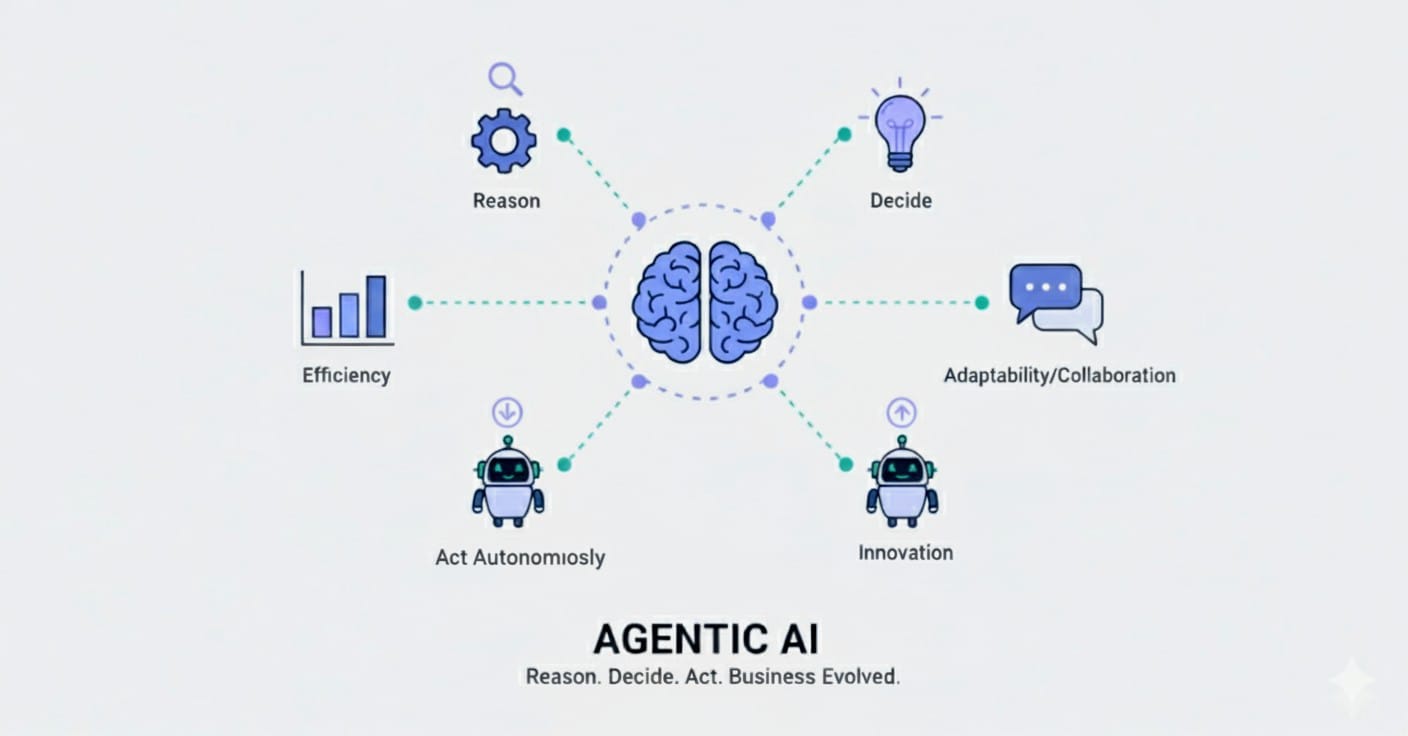
Agentic AI is more than just another buzzword. It represents the next evolution of artificial intelligence—where systems don’t just respond but reason, decide, and act autonomously. For businesses, this shift means unlocking new levels of efficiency, adaptability, and innovation. In this blog, we’ll explore what Agentic AI is, why it matters, and how companies can start embracing it today.
In recent years, businesses have embraced generative AI with enthusiasm. Large Language Models (LLMs) such as GPT have demonstrated the ability to write, summarize, and code with impressive fluency. Yet, as enterprises integrate these tools, an important limitation becomes clear: LLMs are powerful, but they are passive.
This limitation brings us to the rise of Agentic AI, a paradigm that transforms how AI interacts with the world. To understand why Agentic AI matters, let’s explore the distinction.
Generative AI, powered by LLMs, excels at creating text, generating ideas, or providing explanations. Its strength lies in:
Producing high-quality outputs from prompts
Handling unstructured information at scale
Offering speed and fluency in communication
But it stops there. An LLM does not know when to act, cannot independently verify facts, and has no memory of past goals unless explicitly guided. In a business context, this means humans still do most of the orchestration—deciding when to prompt, how to fact-check, and how to connect results to workflows.
Agentic AI builds on LLMs but extends their capabilities. Instead of being a reactive tool, an AI agent can:
Reason about what needs to be done
Plan a sequence of actions across tools or systems
Act autonomously by executing workflows
Learn from prior tasks to adapt in future situations
This shift transforms AI from an assistant that waits for instructions into a collaborator that actively solves problems.
Here’s a simple flowchart comparison:
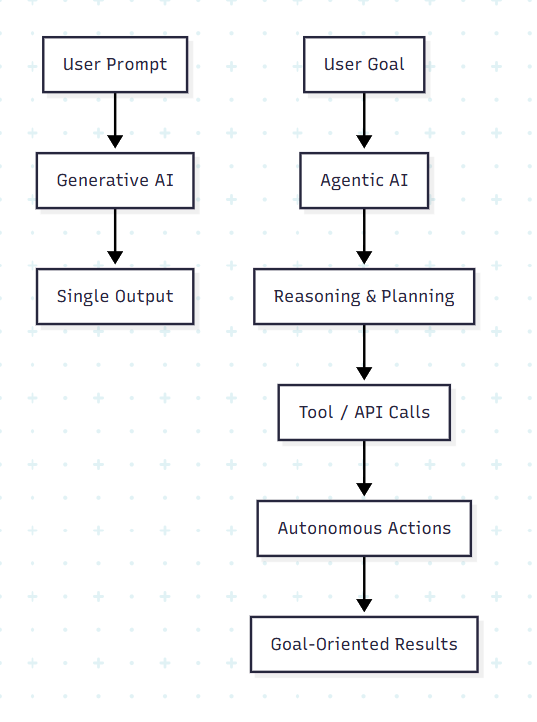
LLM Workflow: Input prompt → Output text
Agentic Workflow: Input goal → Reasoning → Action → Results
The key difference lies in autonomy. LLMs provide outputs, while Agentic AI achieves outcomes.
The distinction is not academic—it has direct business implications.
An LLM can draft a market research summary, but an Agentic AI can actively scan sources, validate data, and deliver a ready-to-use briefing.
Generative AI responds within the boundaries of its training data. Agentic AI can adapt in real time by integrating external tools—APIs, databases, or enterprise systems.
Generative AI enhances workflows. Agentic AI redefines them, embedding intelligence directly into operations.
Generative AI:
A customer service team uses an LLM to draft replies. Each response still requires a human to fact-check, customize, and send.Agentic AI:
An AI agent handles the entire process: understanding customer intent, pulling information from the knowledge base, drafting a response, escalating when necessary, and logging the interaction automatically.
For enterprises, the choice is not about abandoning LLMs—they remain the foundation. The question is whether to stop at generation or to move toward agency.
Generative AI provides productivity gains.
Agentic AI provides business transformation.
Those who adopt Agentic AI early will gain a decisive advantage: faster decisions, scalable operations, and a new capacity to innovate.
LLMs were the first step in showing the power of generative AI. But businesses require more than eloquent answers—they need outcomes. Agentic AI delivers that by combining reasoning, planning, and action.
The future of enterprise AI will not be defined by tools that respond but by systems that collaborate. Agentic AI is that future, and the companies who embrace it today will shape the competitive landscape of tomorrow.
Recent Articles
OpenAI Agents SDK: A Practical Alternative to LangChain, LlamaIndex, and AutoGen
The OpenAI Agents SDK provides enterprises with a production-ready framework for building intelligent AI agents. Unlike LangChain, LlamaIndex, or AutoGen, it balances simplicity, flexibility, and stability—making it ideal for businesses ready to scale AI adoption. Learn when to use it, when not to, and how it compares to other frameworks.